
1855 Wm B Kerr & Co Webster Describe mark 1870 Dominick & Haff 1879 Birks 1888 La Pierre 1873 F&B White & Foster/Foster & BaileyTheodore W Foster & Bros. Co 1815 Gorham 1837 Tiffany & Co Theodore Starr 1890 E &J Bass Whiting & Co FM Whiting 1876 Shiebler 1878 Unger Bros
1791/1810 Black, Starr & Frost
Black, Starr & Frost, America's first jeweler, was founded in 1810 and shaped the luxury revolution of the American jewelry industry. As America's oldest jewelry store, Black, Starr & Frost's history is as mesmerizing as the dazzling works of art they created Black, Starr & Frost is the quintessential American jeweler. Even though the heritage and history of Black, Starr & Frost stretches back further than both Tiffany and Cartier, this American firm’s design brilliance, significance, legacy, and cultural contributions in the jewelry pantheon have been somewhat dimmed by the passage of time.
To reignite the view of this extraordinary legacy is to first glance at early America. This is a story in the decorative arts that began in the late 1700’s with a humble and savvy jewelry and silver craftsman named Isaac Marquand and spans 200 years and an entire continent to a regal Black, Starr & Frost storefront where, to this day, rare objects of beauty await your discerning eye. That the firm began when Beethoven was alive and penning his piano solo Für Elise, later survived the Civil War and then two more World Wars, witnessed the tumultuous 1960’s and the first moon walk, then continued through the merger mania of the 1980’s and now exists into this new century is a wonder in itself and an achievement few commercial enterprises in any line of business can claim.
Known as the premier jeweler to famous families, royalty and celebrities, this fine jewelry salon was so prestigious, Marilyn Monroe mentioned it in the song "Diamonds Are a Girl's Best Friend" she sang in the 1953 blockbuster film, Gentlemen Prefer Blondes. The firm's reputation for garnering the most exquisite gems attracted worldwide attention from famous families, such as the Rockefellers, Vanderbuilts, Guggenheims, and Carnegies, and Hollywood stars, including Diamond Jim Brady and Peggy Hopkins-Joyce, a Ziegfeld girl turned socialite.
In February 1928, Hopkins-Joyce acquired one of the world's largest diamonds from Black, Starr & Frost. The 127.01-carat Portuguese Diamond is presently the largest faceted diamond in the National Gem Collection of the Smithsonian institute in Washington, D.C. It's near flawless clarity and unusual octagonal emerald cut make it one of the world's most magnificent diamonds. Building on a tradition of quality and unconventional style, Black, Starr & Frost served discriminating clients from stores in New York City (including a location at The Plaza Hotel); South Hampton and White Plains, New York; East Orange, New Jersey; West Palm Beach, Florida; and California stores in Costa Mesa and most recently Newport Beach.
Black, Starr & Frost
One of America’s oldest jewellers, Black, Starr & Frost was founded as Marquand & Paulding in Savannah, Georgia in 1801. In 1810, Isaac Marquand moved to New-York and in 1876, with new partners, the name changed to Black, Starr & Frost. In 1929 it merged with Gorham to become Black, Starr & Frost-Gorham Inc. and in 1962, the firm merged again with Marcus & Co.
Considered as one of the greatest American jewellers, Black, Star, & Frost has produced exquisite jewellery in almost every era and was often chose to be America ambassador at world renowned exhibitions’ like the 1851 London Crystal Palace Exhibition, the 1876 Centennial Exhibition in Philadelphia and the 1939 New York World's Fair. Its name is quoted in the Marilyn Monroe’s song "Diamonds Are a Girl's Best Friend".
1766 -1838
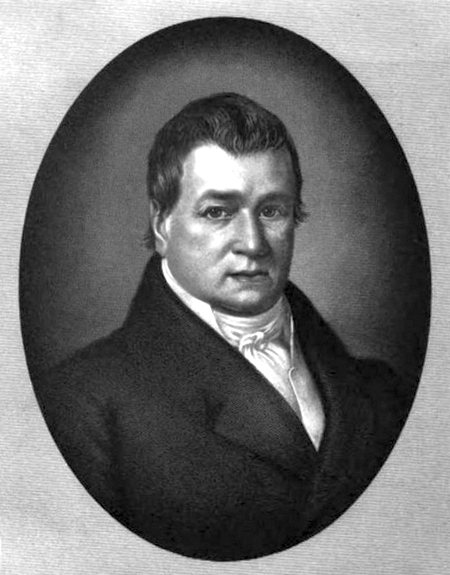
Isaac Marquand • Born: 10 Mar 1766, Fairfield CT • Marriage: Mehitable Perry on 16 Aug 1796 in Fairfield CT • Died: 24 Nov 1838, Brooklyn NY General notes: Silversmith and clockmaker Events in his life were:
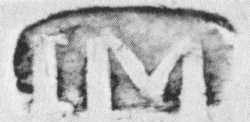
• Alternate Mark • Apprenticed from 1780 to 1787 to Jacob Jennings in Norwalk CT 1 • He worked c 1787 as a silversmith and clockmaker in Fairfield CT 3
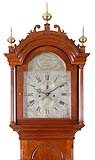
• Tall case clock by WHITING & MARQUAND, c 1790 Private Collection h: 96" photo courtesy of Gary R. Sullivan Antiques Inc. • He was a partner before 1791 with Gamaliel Bradford Whiting in Fairfield CT as WHITING & MARQUAND. 3 • He worked from 1791 to 1796 as a gold- and silversmith, clock- and watchmaker in Edenton NC 3 • Advertised in the State Gazette of North Carolina (New Bern NC), 11 Nov 1791, announcing he had opened a shop on Broad Street, Edenton NC, adjoining Henry Niel's store and offering his services as a goldsmith and silversmith, clockmaker and watchmaker. He proposed to carry on the silversmith's business in all its branches and wanted "a boy, between the age of 14 and 16, as an apprentice." 25 • Advertised in the State Gazette of North Carolina (New Bern NC), 12 Nov 1792, announcing that he had returned and had again commenced business in Edenton. 25 • Edenton NC, 11 Feb 1796: he gave to Jonathan Maltbee a bill of sale for "two buildings joined together making a shop where I formerly worked, ... all my silversmith and watchmaking tools, one negro boy by the name of Sam." Three years earlier, he had bought Sam at a sheriffs sale for £130. 25 • Advertised in the State Gazette of North Carolina (New Bern NC), 17 Feb 1796, informing the people of Edenton that he intended to leave the state and requested all persons indebted to him to make payment to Jonathan Maltbee. 25 • He was a partner from 1801 to 1810 with Cornelius Paulding in Savannah GA as MARQUAND & PAULDING. 15 • He worked from 1804 to 1811 as a merchant in New York City NY he is listed in the 1804 & 1805 city directories as a merchant with a store at 183 Front Street. • He was a partner c 1805 with Hezekiah Lord and Cornelius Paulding in Savannah GA as H. LORD & Co. • He was a partner from 1809 to 1810 with Orlando Harriman and Cornelius Paulding in New York City NY as MARQUAND, HARRIMAN & Co. • He was a partner from 1810 to 1815 with Cornelius Paulding and Josiah Penfield in Savannah GA as MARQUAND, PAULDING & PENFIELD. Penfield had been an employee of MARQUAND & PAULDING for several years before becoming a partner. The business had three main branches: a New York City office (MARQUAND & PAULDING) run by Marquand, the jewelery store in Savannah run jointly by Paulding and Penfield, and a New Orleans branch run by Paulding as C. PAULDING & Co. The complicated arrangement was finally dissolved by mutual consent on 15 November 1815. 15 • Master to Frederick Marquand abt 1812 in New York City NY. 1
• He was a partner from 1815 to 1823 with Erastus Barton in New York City NY as E. BARTON & Co with a store at 166 Broadway. • Master to Josiah Penfield Marquand abt 1822 in New York City NY. 1 • Master to Henry Ball c 1825 in New York City NY. 1 • Master to William Black c 1825 in New York City NY. 1
• He was a partner from 1825 to 1830 with Frederick Marquand in New York City NY as MARQUAND & BROTHER. They continued at 166 Broadway with Isaac still listed in the city directory as a merchant and his son as a jeweler. • He was a partner from 1830 to 1833 with Frederick & Josiah Penfield Marquand, Erastus Osborne Tompkins, in New York City NY as MARQUAND & BROTHERS. • Master to Henry Gurdon Marquand abt 1832 in New York City NY. 1
• He was a partner from 1833 to 1838 with Frederick & Henry Gurdon Marquand, Erastus Osborne Tompkins, William Black, and Henry Ball in New York City NY as MARQUAND & Co., with a new store at 181 Broadway. Isaac married Mehitable Perry on 16 Aug 1796 in Fairfield CT. (Mehitable Perry was born on 11 Mar 1778 in Fairfield CT.)
Shartenberg's Department Store was a six-floor department store located at 765-777 Chapel Street in Downtown New Haven, Connecticut, designed in the neoclassical style.[1] In 2007, it was ranked among the "landmark consumer paradises" of New Haven's past, along with The Edw. Malley Co., Macy's, and Grant's The department store began as A. C. Wilcox, (later called A. C. Wilcox & Company) a dry goods store, in 1836.[3] After the death of A.C. Wilcox, it became The Howe & Stetson Co., and was greatly enlarged. In 1906, the business was purchased and became the Shartenberg-Robinson Department Store, and finally Shartenberg's Department Store.[4] The business was sold to Nelson Miller of New York in 1952[5] and closed its doors April 21, 1962.[6] The building was razed in either 1962[7] or 1964. The Shartenberg Site, as it came to be known, was used as a parking lot until 2008, when groundbreaking for the 31-story 360 State Street building commenced.[8][9] See Patent Dec 6 1888 Larem
Trademark has J.R
Howe & Stetson Mentioned NY Times Sept 13 1900
NY Times Oct 9 1897
1878 Unger Bros
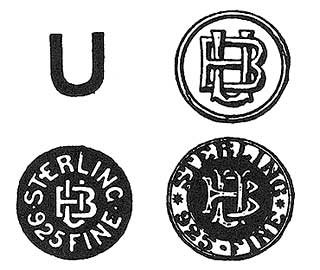
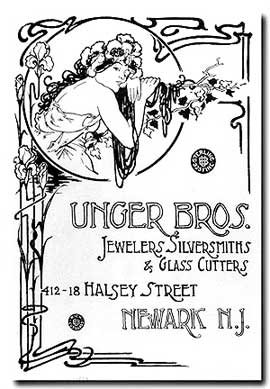
The Unger Brothers Newark, NJ. 1872-1910 (1919) by David E.Fairbrothers The official spelling of the firm's name was Unger Bros. They had both a factory and salesroom located in Newark, NJ. The firm advertised as manufacturing jewelers, silversmiths and glass cutters. The Unger family immigrated to Newark, NJ in 1849 from Germany, and changed the surname to Unger. The oldest son, Herman, established a jewelry business between 1870-1872 and began the manufacture of sterling silver items in 1878. In time all five sons joined the company. Three of the five brothers (William, George and Frederick) died in 1879, and the two survivors (Herman and Eugene) continued the business. Herman, a silversmith, and Eugene, an engraver, were both officers of the firm. This firm reached its economic zenith from 1895 to 1907. Sterling silver bears a stamped circle surrounding a combination trademark and hallmark with the interlaced U and B, plus the words and numbers STERLING 925 FINE. Cut glass with sterling tops bore a trademark on the glass and a trademark/hallmark combination on the silver. In 1880 Eugene Unger and Emma Dickinson married, and her brother, Philemon, joined and eventually became the leading artistic designer at the firm. Philemon developed the extensive line of beautiful repousse Art Nouveau items which became the company's signature designs. Two additional designers employed by Unger Bros. were Otto Leigh and Edward P. Beach. The three men created patents registered by Unger Bros. Unger Bros. molds and dies judged too worn to meet the firm's standards sometimes were sold to other companies which used them to make jewelry. Therefore, Unger Bros. Sterling silver patterns lacking trademarks probably were not manufactured by the Unger firm. Unger Bros. was one of the most creative and premier manufacturers of Art Nouveau sterling silver items in the United States. The company's most popular lines were dresser sets (toilet sets) decorated with fantastic Art Nouveau designs incorporating flowers, heads of women with flowing tresses, ocean waves and/or seashells. Such articles were often ten piece sets, which included cut glass hair receiver, powder, rouge and glove boxes, decorated with repousse silver lids, sterling silver hatpin holders and vase, hand mirror, comb, brushes, shoe horn and button hook. Many attractive patterns were available, with exotic names such as Le Secrete des Fleurs, Reine des Fleurs, Dawn, Love's Dream, Evangeline, Bride of the Wave and Stolen Kiss. In addition to Unger Bros. the following silver companies catered to Art Nouveau connoisseurs in America: Gorham Mfg., Reed & Barton, Mauser Manufacturing Co., Tiffany & Co., Alvin Mfg. Co., F. M. Whiting and Wm. B. Kerr & Co. Many of these companies included silver hatpins in their jewelry offerings. We have seen two large folio-sized catalogs issued by the company in 1904 and 1906 which included artistic and original designs in sterling silver items, including hatpins and hatpin holders. The 1903, 1904 and 1906 Unger Bros. Catalogs illustrate at least 150 hatpin designs, with 60-65% being Art Nouveau. The fantastic 1906 catalog illustrates hanging hatpin holders with a top hook decorated with a fancy ribbon to slip over the adjustment knobs on posts holding the mirror on the bedroom dresser. They also produced a free-standing weighted round-base foot 4 1/4" high holder. Do not confuse the very similar dresser vase with the hatpin holder, both produced by Unger Bros. Some dresser sets have both these items. The difference is that the circular vase top is solid (lacking divisions), while the hatpin holder top consists of five divisions with slightly overlapping bases, which resemble five flower petals. The hanging and free-standing holders feature repousse designs. Hatpins, holders and other items often have sinuous coils of flowers and leaves as part of the decor. Patterns include the lithe female clad in filmy garments with sweeping long hair fading into a caput adorned with flowers, or maidens with up stretched hands grasping at waves that form the caput. Remember, Art Nouveau design involved both form and decoration. Some items had a woman smoking a cigarette and blowing smoke in curls. Selected Unger Bros. Sterling silver pieces were designed to appeal to men, such as silver applied to smoking pipes, pocket knives, match safes, whiskey flasks, ashtrays, cigar jars and boxes, cigar tip cutters, and cigarette cases. These items often had sporting or hunting scenes, horse, duck, fox, ram, bulldog, deer, devil, eagle or fish. We attended the opening reception, lectures and workshop associated with the must-see exhibition "The Glitter & The Gold", celebrating 100 years of jewelry making in Newark, NJ, once the world-famous City of Gold and Platinum and Precious Stones. We had in the show a sterling silver Unger Bros. hatpin holder filled with five hatpins made by Newark silver companies. The 189 page well documented and illustrated catalog will have a positive impact on future jewelry and kindred trades literature.
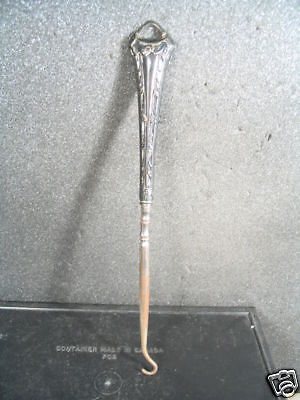
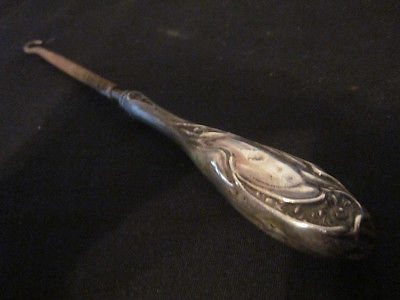
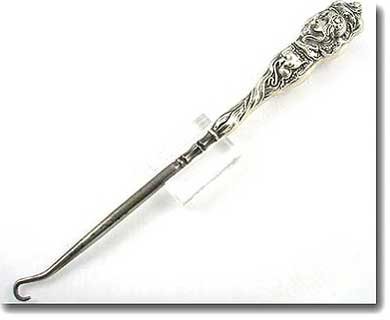
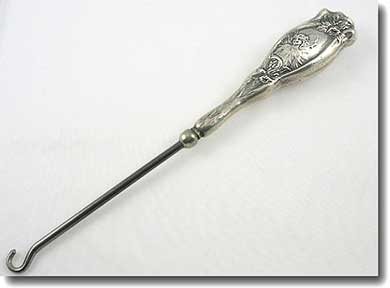
Vintage Unger Bros STERLING HANDLE BUTTON HOOK ....7 3/4".... marked with the Unger Bros hallmark / sterling on the handle. Does need polishing and
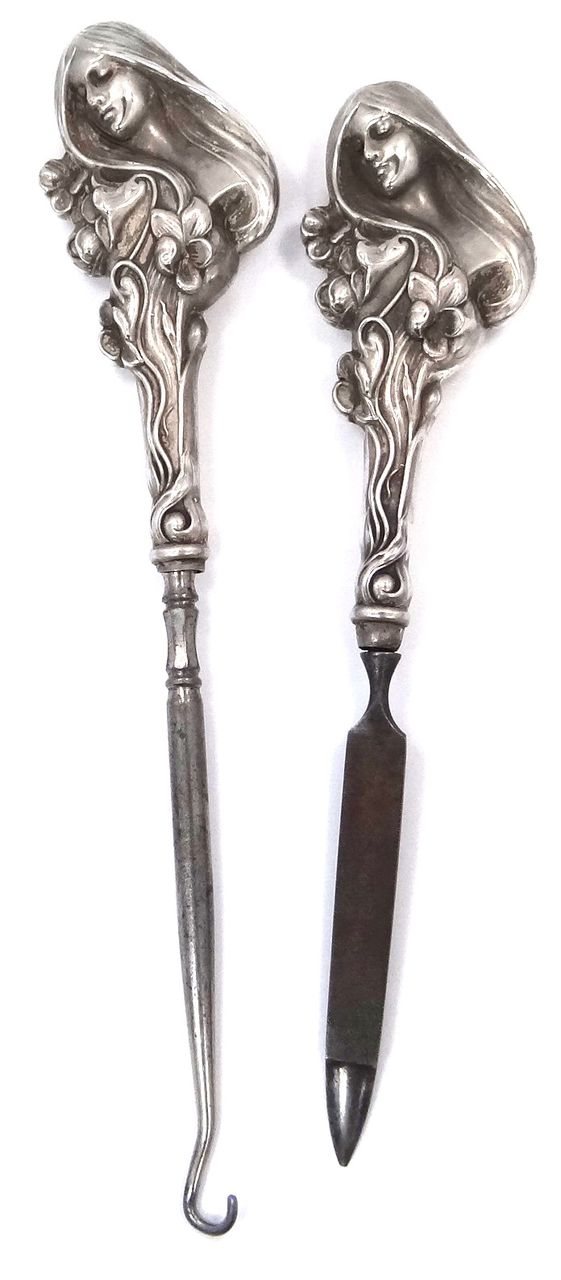
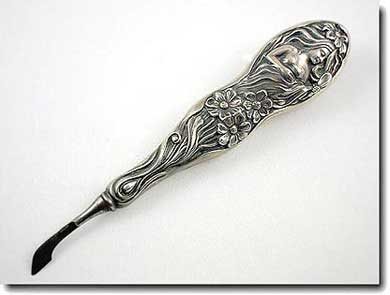
For sale is this extraordinary signed Unger matching set of dresser pieces with a maiden with flowing long hair surrounded by Nouveau lilies and flowers. The shoulders on the girls measure almost 1 1/2" wide and they have no major dents or damage. They are snug with no looseness and I've shown the only dings in the last picture. Item ID: MS002733 Unger Bros. Sterling Maiden & Lilies Nail File & Button Hook Unger Bros. Sterling Maiden & Lilies & Button Hook STERLING 925 FINE
The Unger Brothers hallmarks
Unger Bros. Sterling Silver Art Nouveau Button Hook with Repair
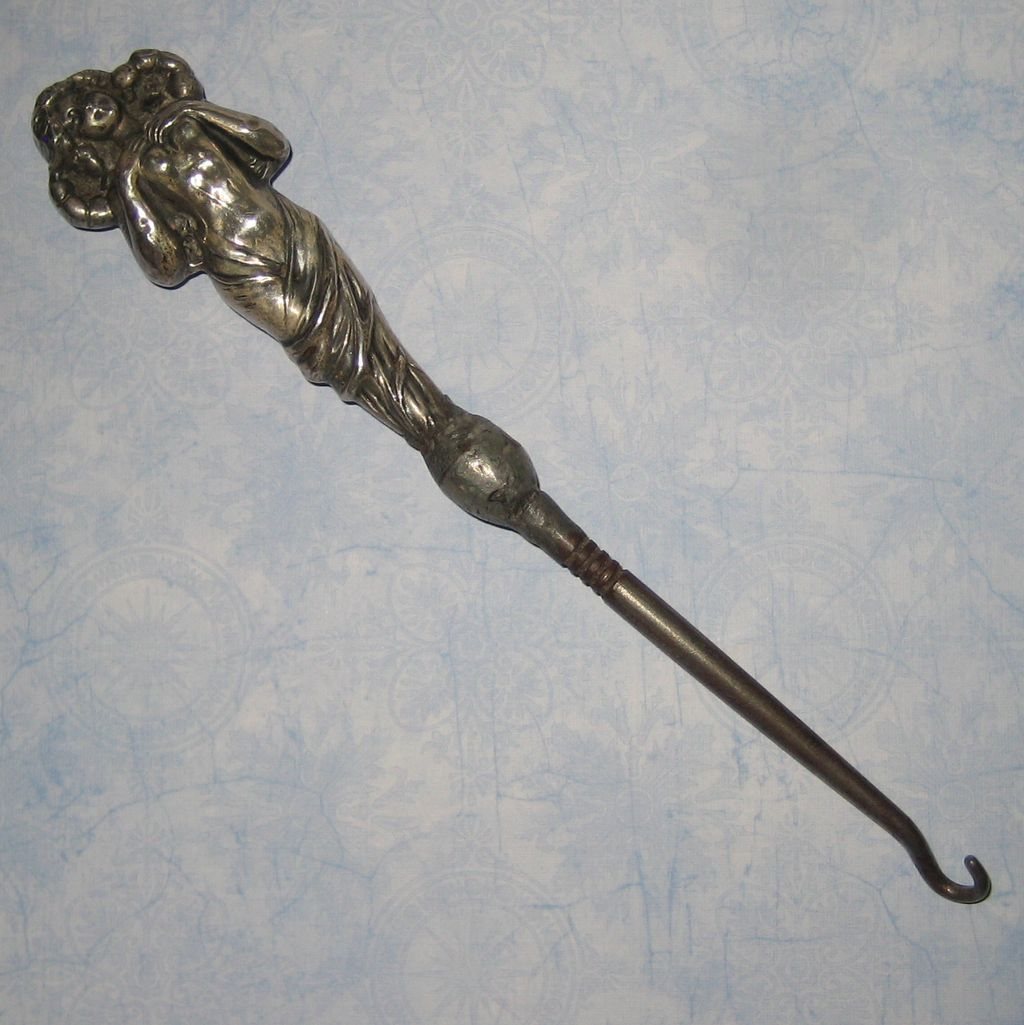
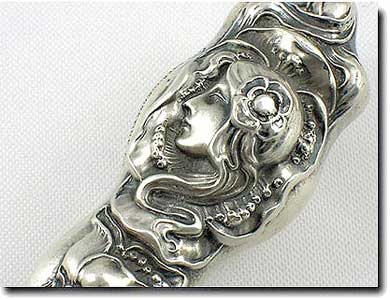
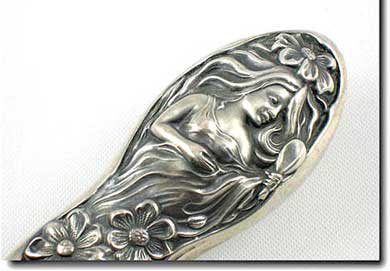
Delightful Unger Bros. button hook, circa 1890 - 1910. The handle is the figure of a woman, draped in diaphanous clothing. She has flowing hair and two lilies grace her shoulders at the back. The button hook handle is sterling, the lower portion is steel. Unger manufactured the handles for a variety of lady's toiletry items of the Victorian era. The handle apparently came loose, and the repair is amateurish. Just above the soldered portion, the mark UNG(ER faded) and ster are legible.
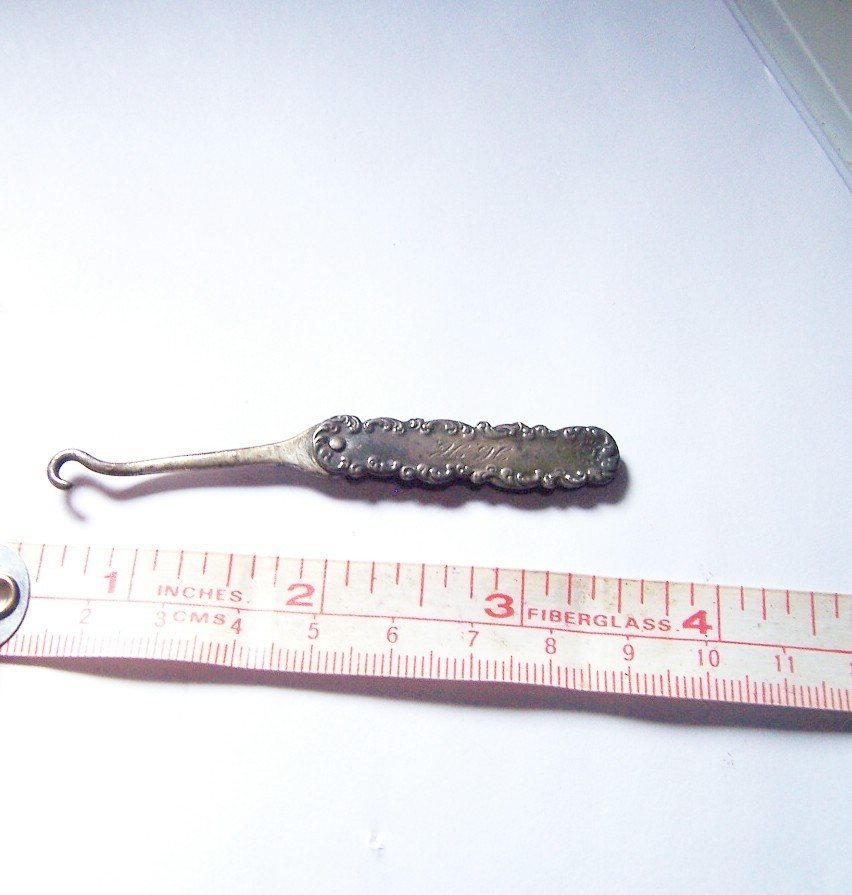
very small 1 3/4 inch when folded, the hook when the piece is folded could actually be used to hang from chain as it folds quite securely. very nice addition to any button hook collection.
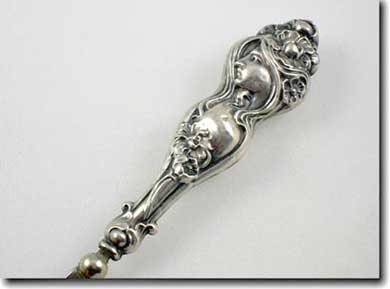
Unger Brothers signed Art Nouveau shoe or boot button-hook with sterling silver handle and steel hook. High repoussé floral pattern of a woman in profile with long flowing hair. The tool measures 7-3/4" total length by 15/16" wide by 7/8" depth. Hallmarked on the edge "Sterling 925 Fine" with double Unger Brothers hallmark. [Circa 1900]
W B Kerr Another popular manufacturer of silver hollow-ware in the Art Nouveau design was William B. Kerr. William B. Kerr, originally Kerr & Thiery, was established by William B. Kerr in Newark, New Jersey in 1855. The company was a maker of flat and tableware, sterling silver and gold dresser ware, and jewelry. William B. Kerr was purchased by the Gorham Corporation in 1906 and moved to Providence, Rhode Island in 1927.
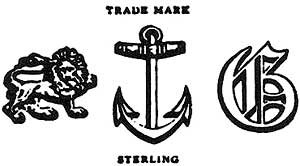
The Gorham Corporation early hallmark.
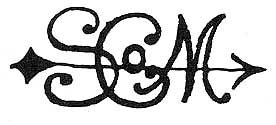
Schmitz, Moore & Company hallmark.
About The Maker: Schmitz, Moore & Company- Newark, NJ. were manufacturers of sterling silver dresser-ware. Advertisement was listed in Jewelers Circular in 1915. Succeeded by Moore & Hofman between 1915-1922.
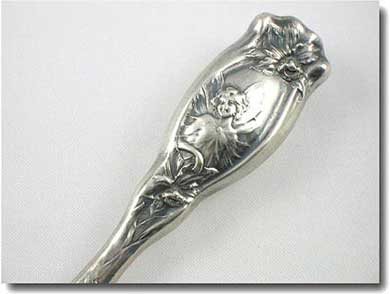
Art Nouveau button hook - sterling silver handle with steel hook. High repoussé floral pattern of winged fairy or sprite, with iris flowers. The tool measures 7-1/2" total length by 15/16" wide by 5/8" depth. [Circa 1900]
Webster Compnay Art Nouveau sterling silver shoe horn with sterling silver handle and steel horn. Measures 7-3/4" by 1" (handle width), 1-1/4" (shoe horn width). A woman with long flowing hair is surrounded by flowers. [Circa 1900]
Sheibler
STERLING 1610. DCC Ref 1881
Plates


Read the complete, fully designed book: American Buttonhooks (PDF).